
Sutton moved 130 older people into permanent care last year, up from 103. Its own scorecard rates that red as tougher CQC rules land with no new money.
Sutton moved 130 older people into permanent residential or nursing care in the year to March 2026, up from 103 the year before. The council’s own performance scorecard rates that red.
The figures are in the papers for the People Committee, which meets at the Civic Offices on St Nicholas Way at 7pm on Wednesday 24 September.
What the numbers show
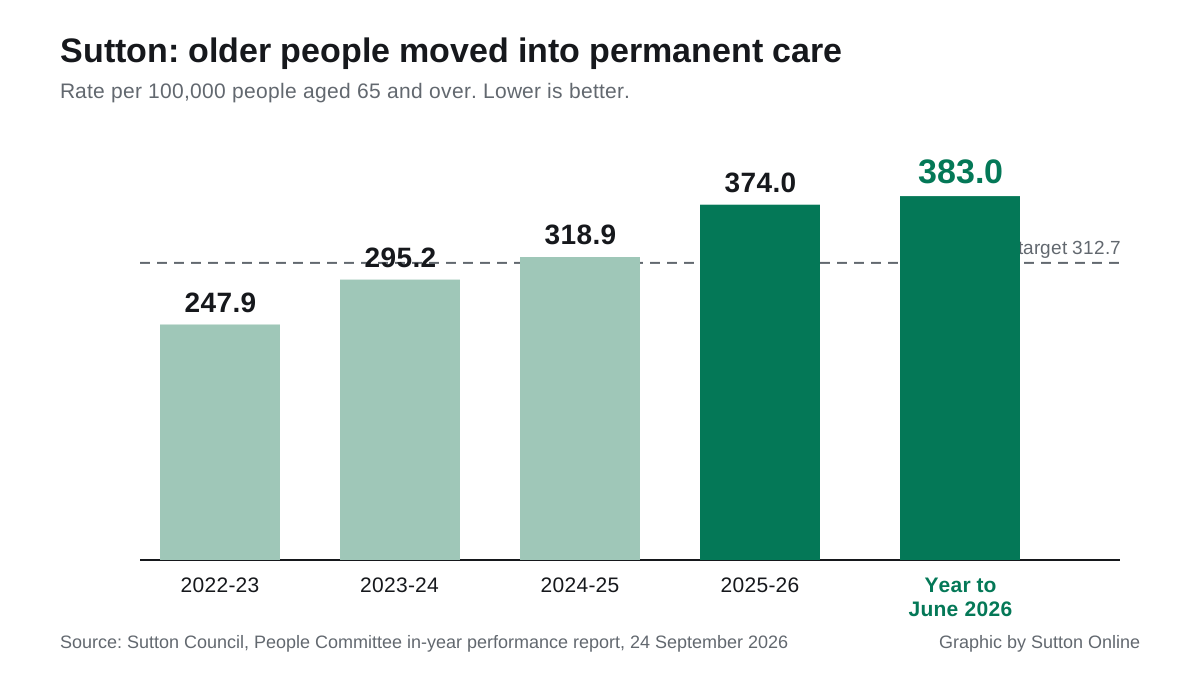
The council measures permanent admissions as a rate per 100,000 people aged 65 and over. On that measure it has risen every year since 2022-23:
| Year | Rate per 100,000 |
|---|---|
| 2022-23 | 247.9 |
| 2023-24 | 295.2 |
| 2024-25 | 318.9 |
| 2025-26 | 374.0 |
| 12 months to June 2026 | 383.0 |
The target is 312.7 or below. The 383.0 recorded for the 12 months to June 2026 is the highest figure printed anywhere in the report, which carries the series back to 2019-20 (Appendix A, in-year performance report). It equates to 126 admissions in the last 12 months.
The council does not hide the trend. Its covering report says performance “has seen a downturn in this metric since the beginning of 2026”, going amber at 320.7 and red at 374.2 by the end of the financial year (People Committee in-year performance report).
It also gives the context that makes the number readable. Sutton’s rate is still well below the London average of 435.8 and the England average of 566.0. The separate report on adult social care goes further, saying Sutton has one of the lowest numbers of over-65s in long term care of any London borough.
So the borough is still placing fewer of its older residents in care homes than almost anywhere in the capital. It is just placing more of them than it was, and more than it planned to.
Where the service is beating its targets
The same report lists four adult social care measures doing well and four that need improvement. The strong ones, all against the council’s own targets:
- carers’ assessments: 68%, against a 60% target, and up from 33.6% in 2023-24
- reviews of people receiving services: 85.2%, against 80%
- independence after hospital discharge: 85.7%, against 81.4%, which means 732 of 854 people aged 65 and over were still living in the community 12 weeks after leaving hospital
The four flagged for improvement:
- permanent care admissions: 383 per 100,000, target 312.7 or below
- safeguarding personal outcomes: 85.1%, target 90%
- reablement through the short term START team: 71.4%, target 74.1%
- paid employment for adults with a learning disability: 10.1%, target 25%, which is 42 people out of a cohort of about 414
On the last one, the council notes that the national indicator it used to report against has been retired, and that it kept a local version going anyway.
A tougher inspection regime, and no money for it
Running alongside the numbers is a second report, on the Care Quality Commission’s new rules for inspecting councils.
Sutton was rated Good, with a score of 70%, in its November 2025 CQC inspection, which it says puts it in the top quartile of published inspections nationally. The CQC then published a new assessment framework on 9 April 2026, and the council is blunt about what that means (Adult Social Care CQC assessment and improvement plan update).
What changes:
- comprehensive inspections now include an on-site visit of up to five days, against two before
- 50 case records must be submitted for inspectors to follow up with residents and carers
- inspectors will sit with social workers and interrogate live cases on the Mosaic case system
- two entirely new types of inspection arrive: annual assurance meetings, each needing a self assessment submitted in advance, and focused assessments between full inspections
The report says the government “has provided no additional funding to manage this administrative burden apart from a small one-off grant”, so the cost has to come out of the existing adult social care budget. It warns that staff and management time “must be diverted away from routine work”.
Sutton has also been paired with Hillingdon Council for a reciprocal one-day peer review in early 2027, run through London ADASS. The findings will be confidential to the two councils.
The money behind it
Adult social care is the council’s single largest area of spending. The performance report puts the budget at £83 million, or 37.5% of the general fund; the CQC report says it accounted for 36% of the council’s total budget in 2025/26.
Even so, the council says it has the lowest adult social care budget of any south west London borough, and the joint lowest as a share of total council spending. Spending per person is 3% below its statistical neighbours in the latest Department of Health and Social Care figures.
Two pressures are named. One is demographic: Sutton already has a larger older population than the London average, and over-65s will be its fastest-growing age group over the next decade. The other is the NHS. The council says it is “increasingly being asked to fund more health needs that cannot legally be funded under section 22 of the Care Act 2014”, the provision that stops a council meeting needs the NHS is required to meet, and it names NHS Continuing Healthcare specifically.
What it means for you
If you are caring for an older relative in Sutton, the practical reading of these papers is that the council is pushing hard on keeping people at home rather than moving them into a care home, and that it is not managing it as well as it planned to.
The things it points to as working are worth knowing about, because you can ask for them:
- a carer’s assessment. The council completed 938 of them out of 1,380 carers in the 12 months to June, a rate it has roughly doubled in two years. It is a right under the Care Act 2014, separate from the assessment of the person you care for.
- technology enabled care. The number of people receiving it at home rose from 648 in April 2025 to 1,071 in April 2026, and the CQC singled it out for praise.
- a review. If circumstances have changed, an early review is how care packages get adjusted rather than left to fail.
There is also a national consultation open. Baroness Casey’s review of adult social care is running a public exercise, the Big Conversation on Care, which the council says it has publicised locally and which concludes by April 2027.
The People Committee papers are public and the meeting is open to the public. Committee Services can be reached on 020 8770 4990.
More Sutton local information: council tax bands, bin collection days, planning applications and parking.
Sources: Sutton Council People Committee, 24 September 2026: the in-year performance report and its Appendix A, and the Adult Social Care CQC assessment and improvement plan update. Committee papers at moderngov.sutton.gov.uk.
Have your say